Predicting multi-modal ETAs.
Bengaluru Vega
Year
2025
Role
Machine Learning
Overview
A machine learning system that predicts accurate arrival times across buses and auto-rickshaws travel for Bengaluru's transit network - fusing models and data sources into one reliable estimate.
The pipeline is split into three independent, Dockerised tasks — bus ETAs, auto-rickshaw ETAs and multi-modal journeys — each with its own preprocessing, training and inference stages, producing JSON predictions that map routes and rides to ETA values.
The challenge
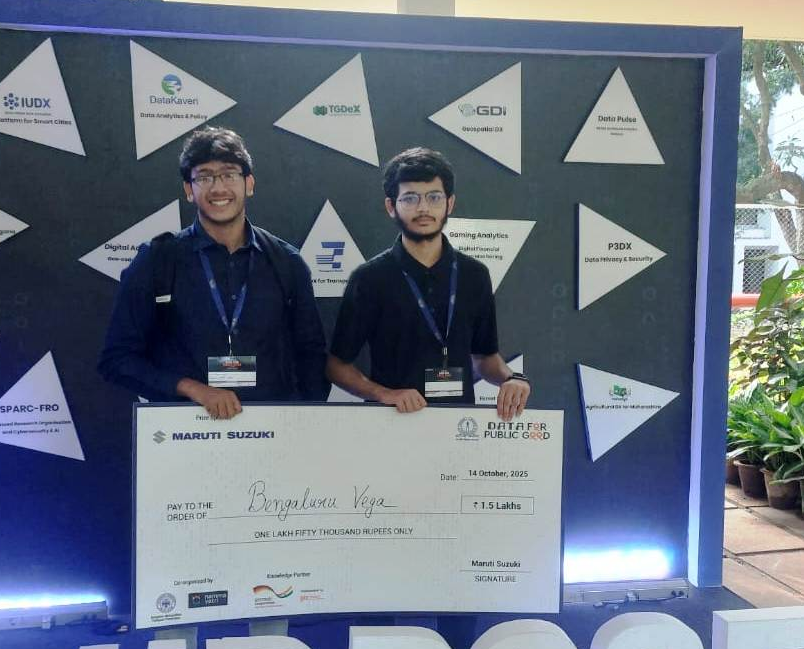
A hackathon co-sponsored by BMTC, Namma Yatri, CDPG and IISc's CiSTUP, hosted on IEEE DataPort, to improve multi-modal transit in one of the world's most congested cities. Three tasks: bus arrival times from live locations, auto-rickshaw trip times including request acceptance and pickup, and total multi-modal journey time. Teams were scored on prediction accuracy, and five finalists demoed at IISc.
Bus segments
An XGBRegressor tuned with Optuna predicts stop-to-stop travel times from historical GPS data.
Auto-rickshaw waits
Wait times are estimated with supply-to-demand-ratio heuristics for ride-hailing.
Travel time
Road-network shortest paths (OSMnx, NetworkX) combined with historical speeds give route-based durations; H3 hexagons handle spatial aggregation.